
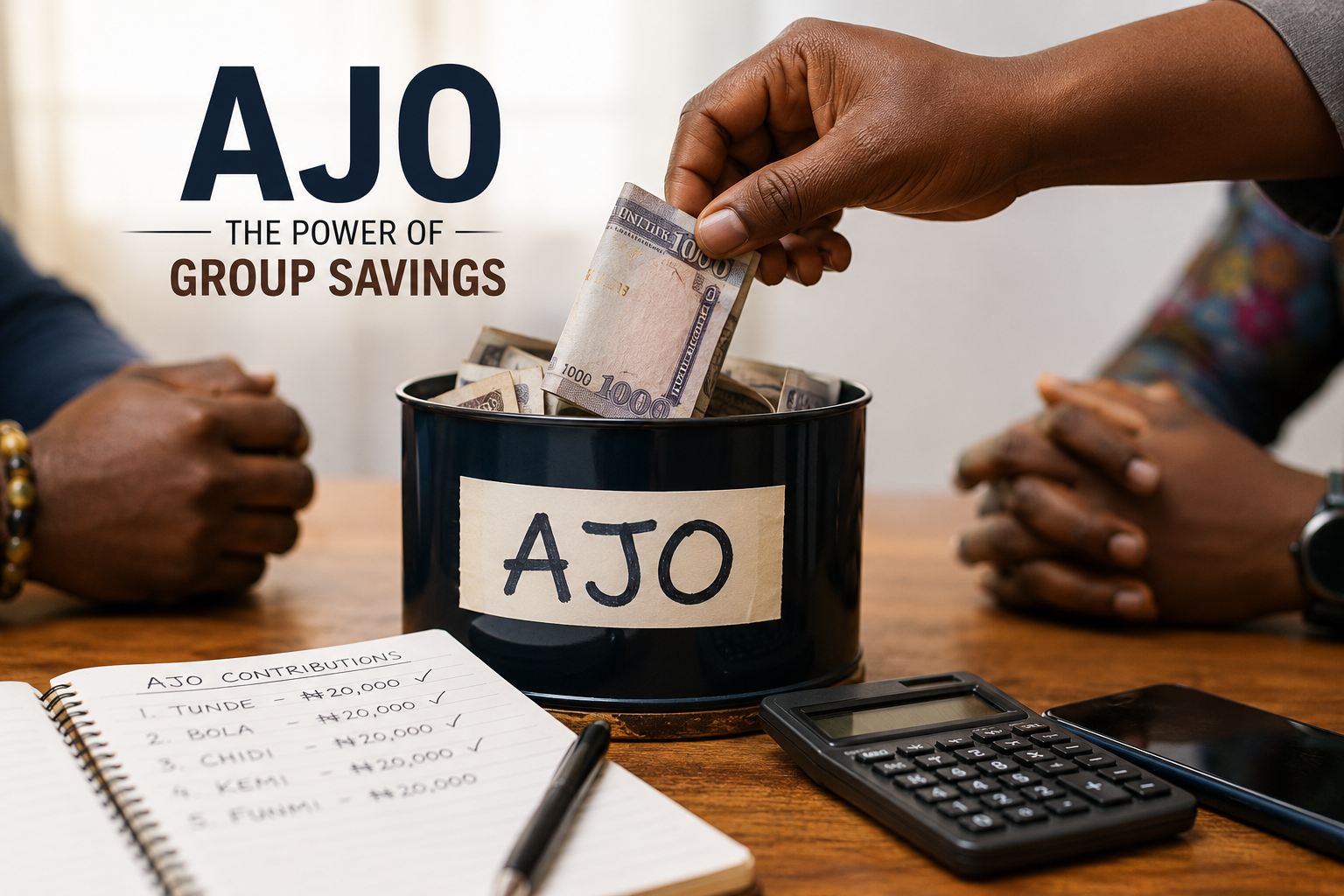
Across Africa, people have developed simple but powerful ways of helping one another save money, access funds, and achieve financial goals. One of the most popular is Ajo.
Known by different names across African communities—such as Esusu, Adashe, Tontine, Susu, or Rotating Savings and Credit Association (ROSCA)—Ajo is a community-based savings system in which a group of people contribute a fixed amount of money regularly and take turns receiving the pooled funds.
Although Ajo has existed for generations, its principles remain highly relevant in today’s economy.
What Is Ajo?
Ajo is a collective savings arrangement where a group of people agree to contribute a specific amount of money at regular intervals. The total contribution is then given to one member of the group at a time until everyone has received their turn.
For example, imagine 10 people agree to contribute ₦20,000 every month.
Each month:
10 × ₦20,000 = ₦200,000
The first member receives ₦200,000 in Month 1.
The second member receives ₦200,000 in Month 2.
The process continues until all 10 members have received ₦200,000.
The group therefore helps each member accumulate a significant amount of money through disciplined, collective saving.
How Does Ajo Work?
A traditional Ajo arrangement usually follows a straightforward process.
1. Members form a group
A group of people who trust one another agree to participate.
They could be:
- Friends
- Family members
- Colleagues
- Traders
- Business owners
- Community members
- Church or mosque members
- Professional associations
Trust is extremely important because members are committing to regular financial contributions.
2. Members agree on the contribution
The group decides how much each person will contribute.
For example:
₦10,000 per week
or
₦50,000 per month
The amount should be realistic enough that members can consistently meet their obligations.
3. The group decides the duration
The duration normally corresponds with the number of members when everyone receives the pot once.
For example:
10 members contributing monthly = approximately a 10-month cycle.
4. Members determine the payout order
The group agrees on who receives the pooled contribution first, second, third, and so on.
The order may be determined by:
- Agreement
- Voting
- Random selection
- Existing need
- A predetermined schedule
5. Contributions are collected
Every member contributes the agreed amount according to the schedule.
The money can traditionally be collected by an appointed coordinator, but modern Ajo groups may use bank transfers or digital payment platforms.
6. One member receives the pooled amount
The total contribution is paid to the member whose turn it is.
The process repeats until everyone has received the pot.
A Simple Example of Ajo
Suppose five entrepreneurs create an Ajo group.
Each person contributes ₦100,000 every month.
The monthly pool is:
5 × ₦100,000 = ₦500,000
| Month | Recipient | Amount |
|---|---|---|
| 1 | Member A | ₦500,000 |
| 2 | Member B | ₦500,000 |
| 3 | Member C | ₦500,000 |
| 4 | Member D | ₦500,000 |
| 5 | Member E | ₦500,000 |
At the end of the cycle, every member has contributed:
₦100,000 × 5 = ₦500,000
And each member has received:
₦500,000
The major benefit is discipline and timing.
A member who might struggle to save ₦500,000 independently can receive the entire amount at once through the collective system.
Why Do People Join Ajo?
Ajo isn’t simply about saving money. It is also about financial discipline, community, trust, and access to lump sums.
1. It encourages disciplined saving
Many people have good intentions about saving but find it difficult to consistently put money aside.
Ajo introduces an obligation.
Because members know that they must contribute regularly, saving becomes a commitment rather than merely a personal intention.
2. It provides access to lump sums
One of Ajo’s biggest advantages is the ability to receive a large amount of money at once.
Someone contributing ₦20,000 monthly might struggle to accumulate ₦240,000.
Through Ajo, however, that person could potentially receive a ₦240,000 pool early in the cycle.
That money could be used to:
- Start a business
- Purchase inventory
- Pay school fees
- Buy equipment
- Pay rent
- Finance a project
- Expand an existing business
3. It builds community
Traditional Ajo is built around relationships.
Members are not simply financial participants. They are part of a community that holds one another accountable.
4. It can provide interest-free access to money
In a traditional rotating Ajo, members generally receive the same amount they contribute over the cycle, without interest being charged.
This can make the arrangement attractive to people who want to avoid borrowing with interest.
However, the economic benefit depends heavily on when a member receives the payout and on the reliability of the group.
5. It can help small business owners
Ajo has historically been particularly useful among traders and small business owners.
A business owner who receives a ₦1 million payout could use it to purchase stock in bulk, invest in equipment, or increase working capital.
Ajo Is More Than Saving
One of the most interesting aspects of Ajo is that it combines several financial concepts.
It is simultaneously a:
Savings mechanism
Community system
Financial discipline mechanism
Access-to-capital mechanism
Accountability structure
This explains why similar systems exist across many countries and cultures.
Ajo and the Modern Economy
Technology is changing how Ajo operates.
Traditional Ajo may involve someone physically collecting cash from members.
Modern Ajo can use:
- Bank transfers
- Mobile money
- Digital wallets
- Payment reminders
- Automated contributions
- Digital records
- Member dashboards
- Transaction histories
- Notifications
This makes it possible to create digital Ajo communities that can operate beyond a single neighbourhood.
For example, ten entrepreneurs in Lagos, Cotonou, Abidjan and Dakar could theoretically participate in the same savings community if the system supporting them handles the relevant currencies, payments and regulatory requirements properly.
Ajo vs. a Traditional Savings Account
Ajo and a bank savings account are fundamentally different.
| Ajo | Traditional Savings Account |
|---|---|
| Community-based | Individual-based |
| Requires group commitment | Mostly personal |
| Members contribute regularly | Deposits are flexible |
| Members receive pooled funds | You withdraw your own balance |
| Strong social accountability | Less social accountability |
| Usually predetermined cycle | Usually open-ended |
| Depends heavily on member trust | Institution manages the account |
Ajo’s strength is the collective commitment.
A bank account’s strength is individual control and institutional infrastructure.
The Risks of Ajo
Despite its advantages, Ajo is not risk-free.
1. Members may default
A member may receive their payout early and then stop contributing.
This can cause serious problems for the remaining members.
2. Fraud
If the person managing the contributions is dishonest, members can lose money.
This is one reason modern Ajo systems need strong financial controls.
3. Poor record keeping
Informal groups may rely on notebooks or memory.
Mistakes can occur when contributions are not properly documented.
4. Personal relationships can complicate financial decisions
When money and relationships mix, disagreements can become difficult to resolve.
5. Lack of formal protection
Traditional informal Ajo may not provide the same protections that regulated financial institutions provide.
How to Make Ajo Safer
A modern Ajo group should establish clear rules before collecting money.
Important rules should cover:
Contribution amount
How much does every member contribute?
Payment deadline
When must contributions be made?
Payout schedule
Who receives the money and when?
Default penalties
What happens if someone doesn’t contribute?
Withdrawal rules
Can a member leave the group before the cycle ends?
Replacement members
What happens if someone can no longer participate?
Record keeping
How are contributions documented?
Dispute resolution
How will disagreements be handled?
Transparency
Every member should be able to see the group’s financial records.
Ajo for Entrepreneurs
Ajo can be particularly powerful when designed around business owners.
Imagine a group of 50 small businesses.
Each business contributes ₦30,000 per month.
The monthly pool becomes:
50 × ₦30,000 = ₦1,500,000
Instead of simply giving the money to members individually, the group could structure its activities around business development.
For example, members could use their payout to:
- Purchase inventory
- Run advertising campaigns
- Buy equipment
- Improve their storefront
- Build websites
- Purchase raw materials
- Expand distribution
- Hire temporary workers
This transforms Ajo from simply a savings system into a potential business growth mechanism.
Ajo and Financial Inclusion
One reason Ajo remains important is that it can reach people who may not be fully served by traditional financial institutions.
Small traders, informal businesses and individuals with irregular incomes may find community-based savings more accessible.
Ajo therefore represents an important part of Africa’s broader informal financial economy.
The challenge is finding ways to combine its traditional strengths—trust, community and discipline—with modern advantages such as technology, transparency and financial security.
The Future of Ajo
The future of Ajo may not look like the traditional person walking around a market collecting cash from members.
Instead, we may see:
Digital Ajo
Business Ajo
Community Ajo
Investment Ajo
Women-focused Ajo
Youth Ajo
Diaspora Ajo
Cross-border Ajo
The fundamental idea remains the same:
People come together, contribute consistently, and use collective financial discipline to help one another reach larger financial goals.
Technology simply makes it possible to organize that community at a much larger scale.
Conclusion
Ajo is one of Africa’s most enduring financial innovations.
Its simplicity is its greatest strength.
People agree to contribute.
They hold one another accountable.
One person receives the collective contribution.
The process continues until everyone gets their turn.
But Ajo’s deeper value goes beyond money.
It demonstrates the power of collective action.
In an increasingly digital African economy, the opportunity is not necessarily to replace Ajo. It is to modernize it responsibly—combining traditional community trust with technology, transparency and better financial management.
Ajo may be an old idea, but the principle behind it remains remarkably relevant:
When people save and build together, they can accomplish things that may be difficult to accomplish alone.